

Saint Anthony
Saint Anthony was born in 1195 AD at Lisbon, Portugal, where his father was a captain in the royal army. When he was fifteen he joined the Congregation of Cannons Regular of Saint Augustine in a monastery at Coimbra, Portugal. There he devoted his life to piety and study. Members of the Order of Friars Minor, founded by Saint Francis, established a monastery in Coimbra. Anthony was greatly influenced by their evangelism, poverty, and simplicity of life. In 1219 several missionaries of the Order were martyred in Morocco. Wishing to earn the same end, Anthony asked for permission to join the Order and go to Italy. His wishes were granted and he made the journey.
No sooner had he arrived in Morocco than he became seriously ill. After recovering, but still too weak to fulfill his mission, he sailed for Portugal. Encountering a storm his ship was driven eastward to haven in Sicily. He was given shelter by Franciscans and there he remained. He was to spend the rest of his life in Italy. In 1221 he was sent to Assisi where the General Chapter was held in May. Still too sickly, the Provincial sent him to Foli. There he lived quietly, but not for long. He was directed to give a sermon at an ordination. While doing so he was miraculously infused with great wisdom and eloquence. People were amazed.
Saint Francis soon heard of this and asked him to preach and teach throughout Italy. Anthony obeyed and soon people flocked to hear him. He became a great defender of the faith and as a result of his efforts there were many conversions and other near miraculous occurrences. He soon resided primarily in Padua, the site of an important university where he taught. He became Provincial General of northern Italy. His days were long and full in the service of Christ and the people. He exhausted himself, became ill, and died in 1231, at the age of thirty six. Many miracles occurred at his tomb and in the following year he was canonized by Pope Gregory IX.
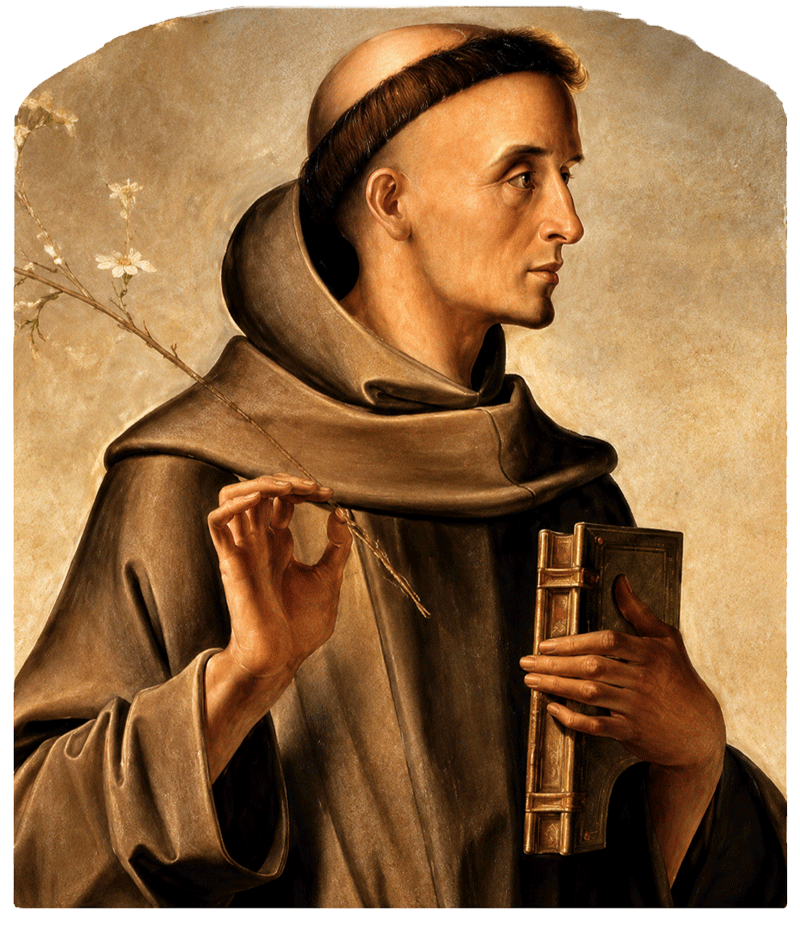
In 1946 he was made a Doctor of the Church because of his achievements as a theologian. He is a patron of the oppressed, finder of lost articles, patron of the American Indian, patron of the mail, and fighter of corruption. He is usually shown holding the Child Jesus and often with a book, a lily, and bread. The practice of picturing him with the Child is said to come from a story that while visiting a friend he was found holding the Child, breathtakingly beautiful and surrounded by bright light.
This information was adapted from Herald of the Immaculate and American Catholic.
Saint Elizabeth
Saint Elizabeth was born in Hungary in 1207 AD, the daughter of the King of Hungary, Alexander II. At the age of four she was betrothed to the child, Louis, son of the Landgrave of Thuringia to whose court she was sent to be raised and educated. She and Louis were married in 1221 and were gifted with four children. En-route to a crusade, Louis died. Elizabeth gave birth to their fourth child shortly thereafter. At the age of twenty she found herself a widow and mother of four.
From a young age Elizabeth showed a propensity for prayer and good works. Amidst the grandeur and activity of the royal court she maintained an active prayer life, which overflowed into love for the poor. Without shirking her duties as a wife and mother Elizabeth the queen visited the poor twice daily, morning and evening. She spent all of her revenue from her husband’s four principalities on the poor. She even built a hospital for the poor at the foot of the castle. She was known for taking food and clothing to the poor, carrying the sick on her back, and selling her grand royal gowns to further assist the poor of her husband’s kingdom.
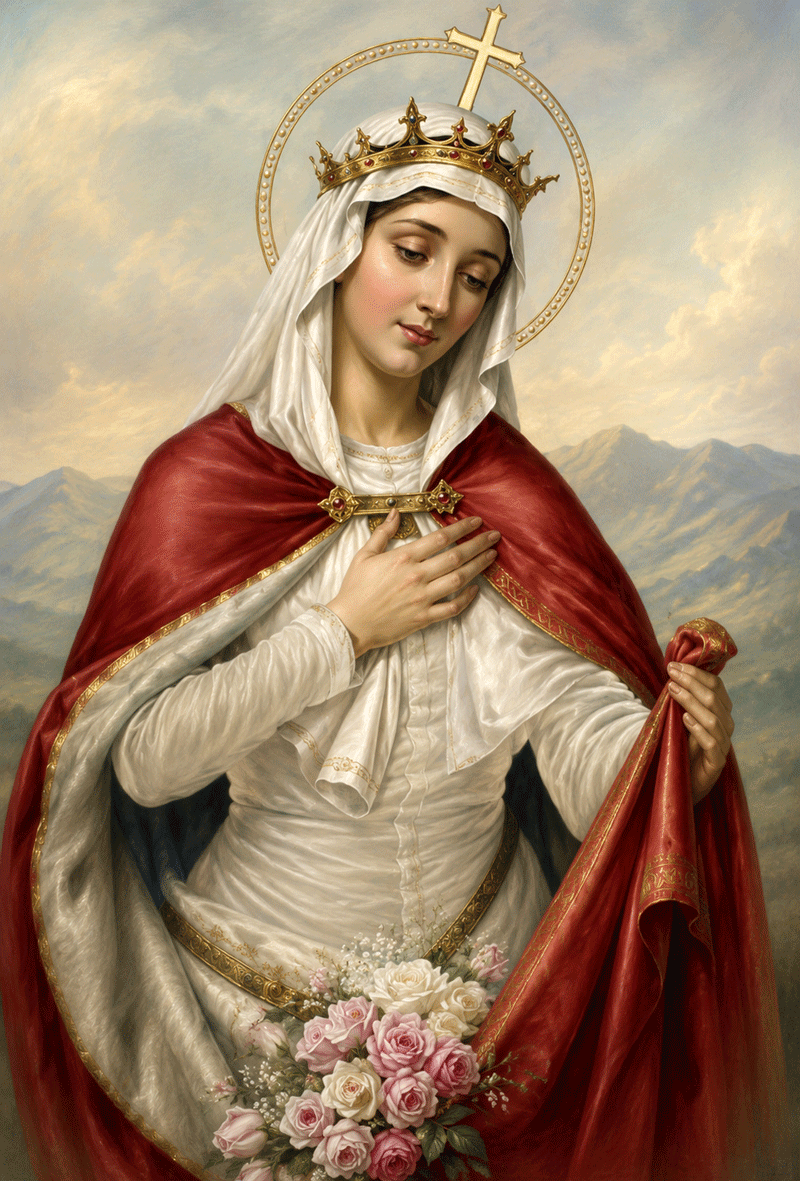
Though Louis supported Elizabeth’s works of charity, many in the royal court did not. She often suffered ridicule at the court. Consequently, she often left the castle inconspicuously each day. On one occasion, as she set out to work with the poor the King surprised her. On unveiling her mantle where she carried bread for the poor, the King saw only roses. If you look closely at the statue of Saint Elizabeth in the church you will see a loaf of bread in her hand and roses in her mantle.
Upon the death of her husband, she renounced all her possessions at court and became a Third Order Franciscan. She continued to work with the poor until her death in 1231. She was only twenty four years old! Providentially for us, there was another saint who died that year, Saint Anthony of Padua, another Franciscan. Saint Elizabeth of Hungary is the great aunt of Saint Elizabeth of Portugal! She is the patroness of bakers, beggars, brides, charitable workers, countesses, falsely accused people, hospitals, in-law problems, people ridiculed for piety, toothaches, and widows, to name a few. Her feast day is celebrated on November 17.